
When I first became a manager, I thought accountability meant being tough. I thought it meant pointing out mistakes quickly, tightening expectations, and making sure everyone knew where the bar was.
It didn’t take long to realize that approach only creates fear — not performance.
Real accountability isn’t about pressure. It’s about clarity, consistency, and genuine care for the people you lead. High-performing teams don’t succeed because they’re scared to fail. They succeed because they trust their leader and understand what’s expected of them.
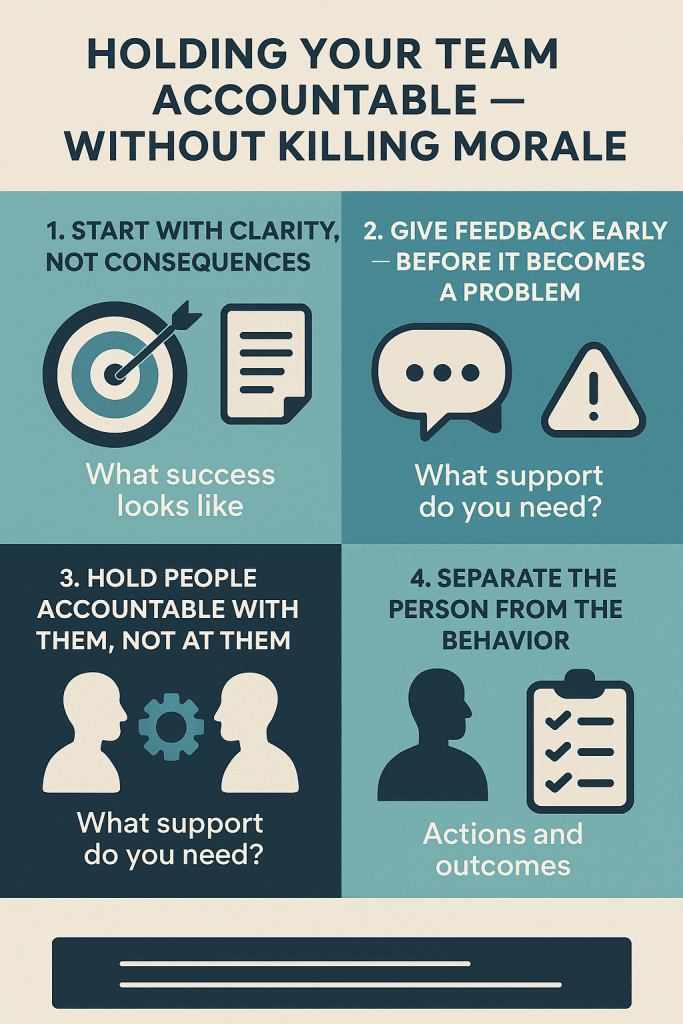
1. Start With Clarity, Not Consequences
People can’t meet expectations they don’t understand. Many performance issues come from assumptions or miscommunication — not lack of effort.
To create clarity, make sure your team knows:
- What success looks like (concrete outcomes, not vague goals)
- How progress is measured
- How and when updates should be shared
- What decisions they own vs. what requires alignment
When expectations are clear, accountability becomes a shared agreement — not a surprise conversation.
Accountability without clarity feels like punishment.
Accountability with clarity feels like alignment.
2. Give Feedback Early — Before It Becomes a Problem
One of the best ways to protect morale is to give feedback when the issue is small — not when the frustration has built up.
For first-time managers, the fear of being “too direct” often leads to silence. But silence grows resentment. If you wait too long, the conversation becomes heavier than it needs to be.
Use a simple prompt to start early:
“Can I share something small I’m noticing before it becomes a bigger issue?”
This approach is honest, respectful, and signals partnership — not judgment.
3. Hold People Accountable With Them, Not At Them
Accountability conversations are most effective when they feel collaborative. Instead of saying, “You need to fix this,” try framing it as a shared problem:
- “Let’s talk about what got in the way.”
- “What support do you need to meet this goal?”
- “How can we prevent this from happening again?”
The goal is not to assign blame — it’s to understand the root cause and remove obstacles.
This reduces defensiveness and builds ownership.
4. Separate the Person From the Behavior
One of the quickest ways to damage morale is to make issues feel personal. Keep the focus on actions and outcomes, not on the employee’s character.
Instead of:
❌ “You’re disorganized.”
Try:
✅ “I’ve noticed deadlines are getting missed. Let’s look at your workload and systems together.”
People improve when they feel respected, not attacked.
The Everyday Leader Takeaway
Accountability is not about being the “tough leader.” It’s about being the consistent leader.
The leader who sets clear expectations.
The leader who communicates early.
The leader who supports, guides, and helps people grow.
When accountability is rooted in clarity and care, morale doesn’t suffer — it strengthens.
Because everyday leaders don’t just demand results.
They create the environment where results are possible.
Author: Anthony Nichols
Leadership Director & Mentor for First-Time Managers
At The Everyday Leader, I share real-world lessons on communication, culture, and leading teams with clarity and heart.


Leave a Reply