
Accountability is one of the most misunderstood concepts in leadership.
Some managers think it means being strict. Others avoid it entirely because they don’t want to feel confrontational. And many first-time managers fall into the trap of assuming accountability only matters after something goes wrong.
But the truth is this:
Accountability isn’t a reaction — it’s a culture.
It’s built long before deadlines slip, communication breaks down, or performance dips. And when done well, accountability doesn’t create pressure… it creates clarity, confidence, and trust.
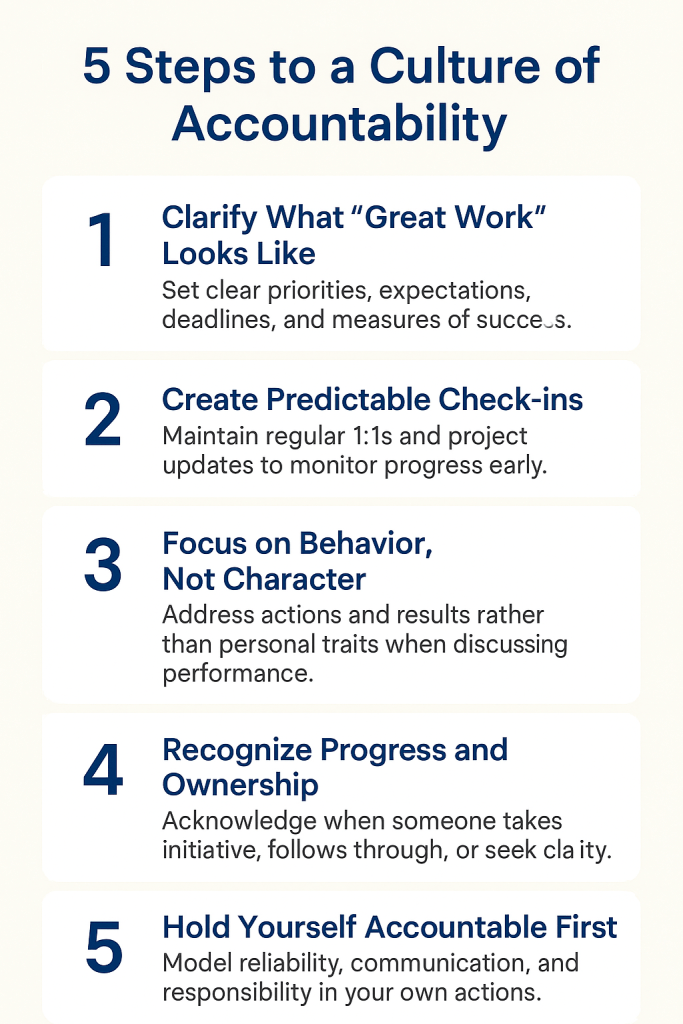
Here’s how everyday leaders build a culture where people take ownership, follow through, and feel proud of their work.
1. Clarify What “Great Work” Looks Like
Accountability starts with alignment — not correction.
Your team should always know:
- What the priorities are
- What success looks like
- What deadlines mean
- How progress will be measured
- Who owns which responsibilities
Unclear expectations create inconsistent performance. Clear expectations create empowered employees.
Try saying:
“Here’s what we need, here’s why it matters, and here’s how we’ll measure it.”
Clarity isn’t micromanagement.
Clarity is respect.
2. Create Predictable Check-ins — Not Surprise Conversations
A culture of accountability isn’t built in annual reviews or emergency meetings. It’s built in consistent rhythms:
- Weekly 1:1s
- Quick pulse updates
- Brief project check-ins
These small moments keep communication flowing and prevent problems from piling up.
Predictable check-ins turn accountability into a partnership — not a performance trap.
3. Focus on Behavior, Not Character
Nothing shuts down accountability faster than making someone feel like they are the problem.
Swap this:
❌ “You’re unreliable.”
For this:
✅ “I noticed the last two deadlines slipped. Let’s look at what got in the way.”
Accountability should feel like collaboration, not criticism.
When you focus on actions, not identity, people feel safe to improve.
4. Recognize Progress and Ownership
In cultures with strong accountability, recognition is just as important as correction.
Don’t only talk about accountability when something is wrong.
Highlight when someone:
- Took initiative
- Followed through early
- Asked for clarification
- Owned a mistake and fixed it
- Helped a teammate
Positive accountability builds momentum.
Negative accountability builds fear.
5. Hold Yourself Accountable First
Nothing shapes culture more than how the leader behaves.
If you:
- Follow through
- Model communication
- Take responsibility
- Admit mistakes
- Stay consistent
Your team will follow.
If you don’t — no amount of process will fix it.
Accountability starts with the leader’s example.
The Everyday Leader Takeaway
Accountability isn’t about catching people doing something wrong.
It’s about creating a team that knows what matters, follows through, and trusts each other to deliver.
When you build accountability into the culture —
not the crisis,
not the conflict,
not the performance review —
your team becomes more confident, more aligned, and more resilient.
Because everyday leaders don’t enforce accountability.
They inspire it.
Author: Anthony Nichols
Leadership Director & Mentor for First-Time Managers
Empowering new leaders with practical tools, real stories, and the confidence to build strong, accountable teams.


Leave a Reply