
One of the biggest surprises for new managers is how quickly difficult conversations become part of the job. Whether it’s addressing performance issues, resetting expectations, or resolving tension between teammates, these conversations are unavoidable — and they often feel uncomfortable.
But here’s the truth every great leader learns:
Difficult conversations don’t damage trust when done well. They build it.
Your team doesn’t expect perfection. They expect honesty, clarity, and respect. When you handle tough moments with calm confidence, people feel safer, not shaken.
Here’s a simple, repeatable framework to help you navigate difficult conversations without fear, defensiveness, or spiraling emotions.
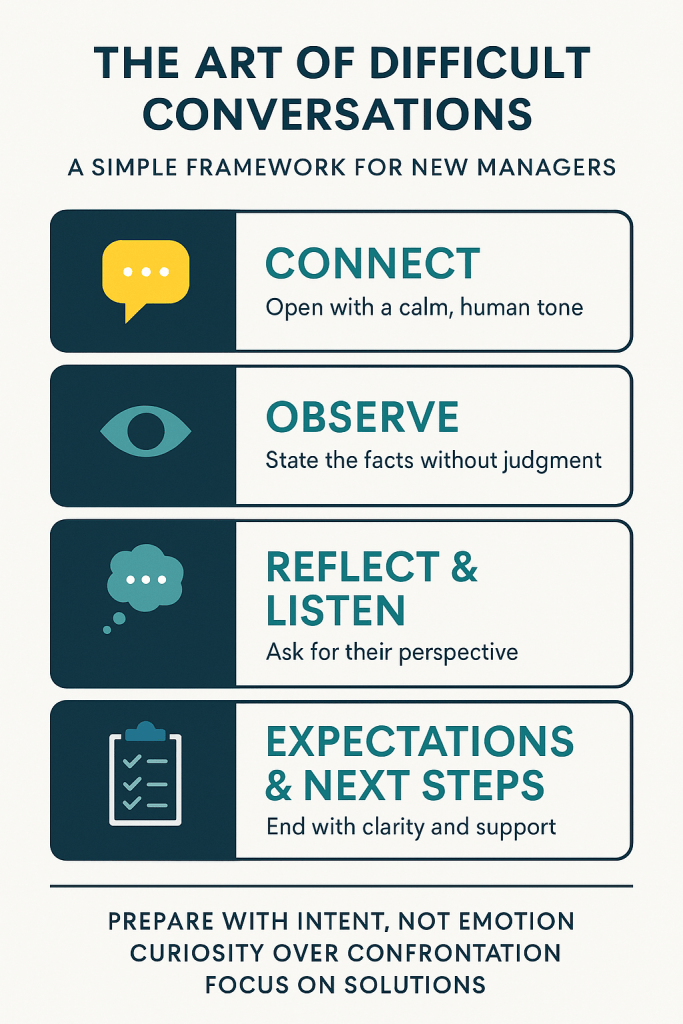
1. Prepare With Intent, Not Emotion
Most difficult conversations go sideways because they start too quickly — fueled by frustration or stress.
Before you speak with your employee, take a moment to ground yourself:
- What is the core issue I need to address?
- What outcome do I want from this conversation?
- What part of this is fact, and what part is my interpretation?
- How can I speak with respect, not emotion?
A centered leader creates a centered conversation.
2. Use the “C.O.R.E.” Framework
This four-step structure keeps the conversation honest, clear, and compassionate.
C — Connect
Open the conversation with calm, human tone:
“I want to talk about something important because I care about your success.”
This reduces anxiety and signals partnership, not punishment.
O — Observe
State the facts without judgment:
“I’ve noticed the last three deadlines were missed.”
Stick to observable behaviors — not assumptions.
R — Reflect & Listen
Ask for their perspective:
“How do you see it?”
“What happened from your point of view?”
Listen fully. Many problems dissolve simply because someone finally feels heard.
E — Expectations & Next Steps
Finish with clarity and support:
“Here’s what needs to happen moving forward… How can I support you in meeting this?”
Clarity creates confidence. Support creates trust.
3. Stay Curious, Not Confrontational
The moment you shift from curiosity to judgment, the conversation becomes a battle.
Use phrases like:
- “Help me understand…”
- “Walk me through what happened…”
- “What do you think got in the way?”
Curiosity lowers defenses and opens the door to real problem-solving.
4. Separate the Person From the Problem
Critique the behavior, not the identity.
Instead of:
“You’re not reliable.”
Try:
“When the report wasn’t submitted, it created delays — let’s figure out how to prevent that next time.”
This builds dignity while still addressing performance.
The Everyday Leader Takeaway
Difficult conversations don’t define you as a leader — how you handle them does.
When you prepare with intention…
When you speak with clarity…
When you listen with humility…
When you focus on solutions, not blame…
…you turn hard moments into leadership moments.
Because everyday leaders don’t fear difficult conversations —
they use them to build stronger relationships and stronger teams.


Leave a Reply