
One of the hardest transitions for first-time managers is learning how to trust your team while still staying informed.
Most managers don’t start out wanting to micromanage — it usually comes from a good place: wanting things done well, wanting to prevent mistakes, and wanting to prove you can lead.
But micromanaging slows teams down, erodes confidence, and bottlenecks growth.
The goal isn’t full control.
The goal is clear systems that let you lead without hovering.
Here are five practical ways to reduce micromanagement while staying aligned and confident in your team’s work.
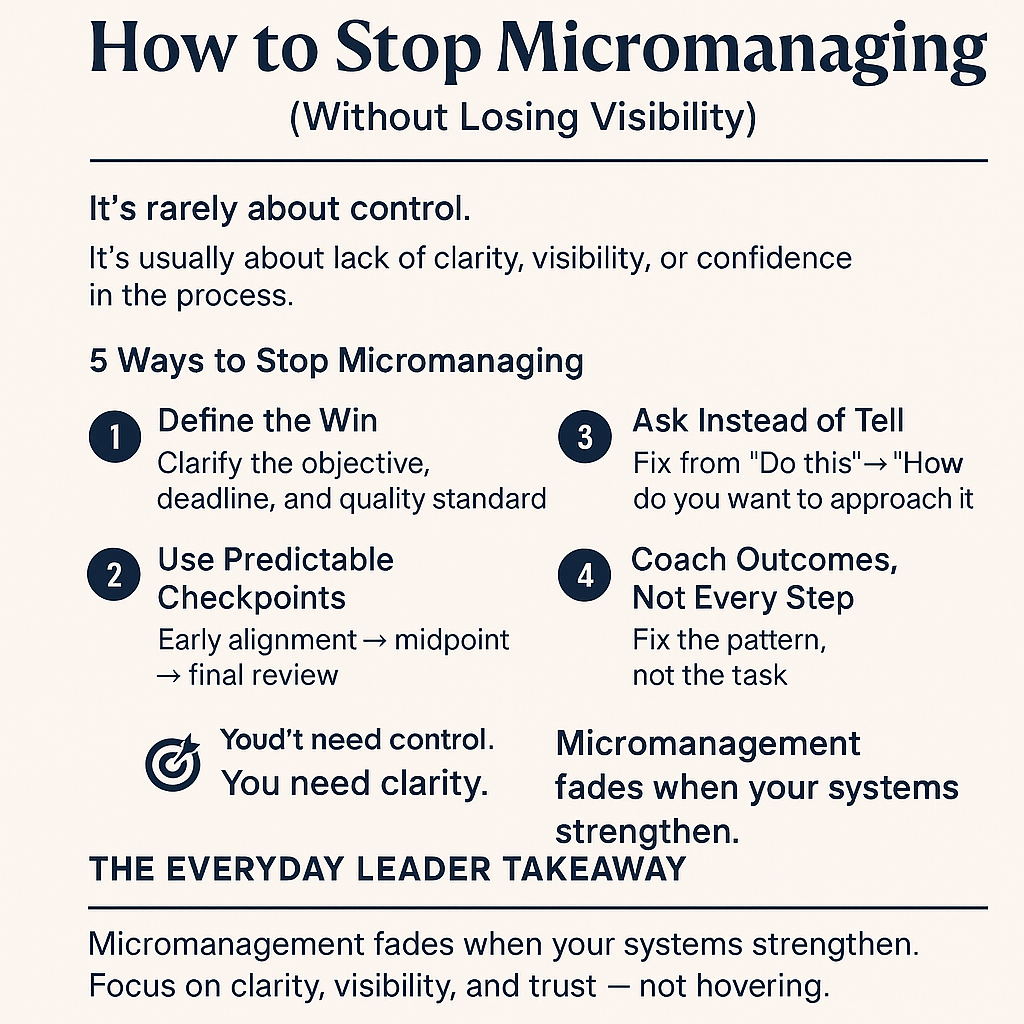
1. Shift From “Doing” to “Defining the Win”
Micromanaging happens when the manager focuses on how instead of what.
Instead of giving detailed steps, define:
- The objective
- The deadline
- The quality standard
- The constraints
- The non-negotiables
When the team understands the win, they can choose their own path to get there — and you get better outcomes with less involvement.
2. Use Checkpoints Instead of Constant Check-ins
Micromanagers check in to reduce anxiety.
Great leaders check in to reinforce alignment.
Set predictable checkpoints:
- Early alignment check
- Midpoint progress review
- Final review or delivery
Predictable rhythm = less hovering, more clarity.
3. Make Work Visible Without Hovering
You don’t need to micromanage if you can see the work.
Use simple visibility tools:
- A shared to-do list
- A weekly priorities doc
- A progress tracker
- A brief Monday kickoff message
Visibility creates trust — not because you’re controlling the work, but because you understand what’s happening without interrupting flow.
4. Build the Habit of Asking Instead of Telling
Micromanagement sounds like:
“Do it this way.”
Leadership sounds like:
“What options are you considering?”
“How do you want to approach it?”
“What do you think the best next step is?”
Questions shift ownership from you → the team.
People commit more to plans they helped create.
5. Coach Outcomes, Not Every Step
When something goes wrong, your instinct may be to take back control.
But that reinforces micromanagement.
Instead, coach the outcome:
- What happened?
- What did we learn?
- What will we do differently next time?
You build capability, judgment, and trust — and each cycle reduces the need to intervene.
The Everyday Leader Takeaway
Micromanagement doesn’t come from lack of trust — it comes from lack of clarity, lack of visibility, and lack of systems.
When you:
Define the win,
Use predictable checkpoints,
Make work visible,
Shift to questions, and
Coach outcomes…
…you stop hovering and start empowering.
Because everyday leaders don’t control people —
they build teams that can succeed without constant supervision.


Leave a Reply