
Most performance problems don’t come from lack of effort — they come from unclear expectations.
As a first-time manager, you might assume you’ve been clear… only to realize later that your team heard something different, filled in gaps, or guessed what “good” looked like.
Clear expectations aren’t about giving more instructions.
They’re about creating shared understanding.
Here’s a simple framework to set expectations that stick — and eliminate confusion before it starts.
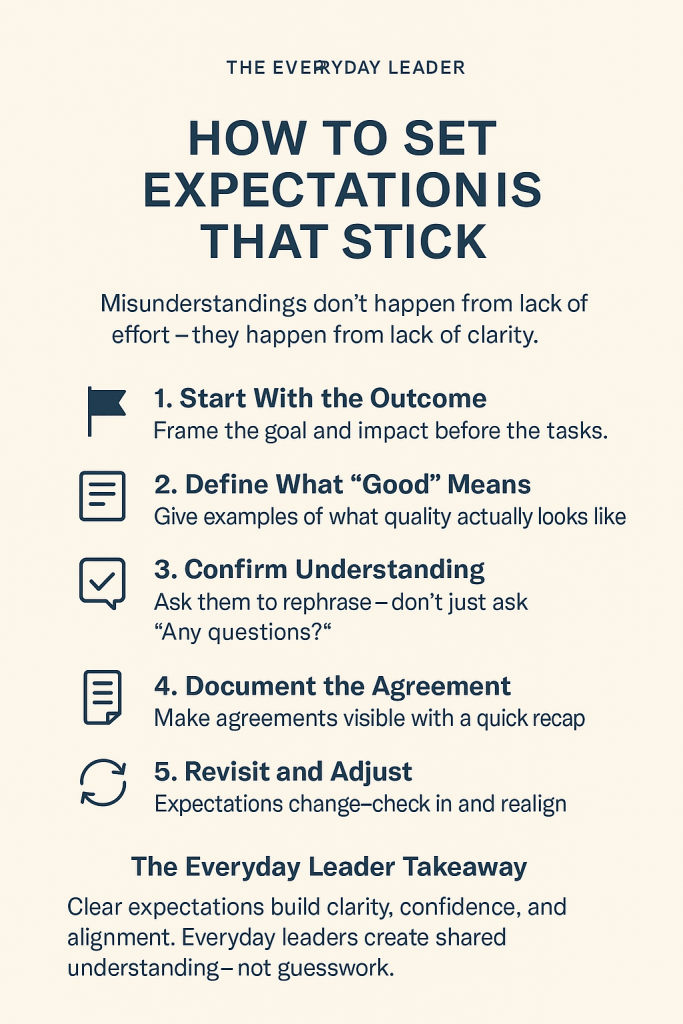
1. Start With the Outcome, Not the Task
When expectations go wrong, it’s usually because the conversation focused on what to do, not why it matters.
Always lead with:
- The goal
- The impact
- What success actually looks like
Outcomes give context. Tasks give direction.
Teams need both — but outcomes always come first.
2. Define What “Good” Means (With Examples)
People don’t misinterpret because they’re careless.
They misinterpret because “good,” “urgent,” or “high quality” means something different to everyone.
Prevent this by giving concrete examples:
- “Good looks like responding to emails within one business day.”
- “High quality means double-checking data before sending.”
- “Urgent means I need it today, not this week.”
Specifics eliminate guessing.
3. Confirm Understanding Instead of Asking ‘Any Questions?’
“Any questions?” closes the conversation.
“Tell me how you’re understanding this” opens it.
Try:
- “How would you approach this?”
- “What’s your first step?”
- “What timeline are you thinking?”
People rarely ask clarifying questions on their own.
Make understanding part of the process.
4. Document the Agreement (Lightly)
Documentation doesn’t need to be formal — it just needs to be visible.
Use a:
- Quick follow-up message
- Shared doc
- One-line Slack recap
- Bullet-point list in your 1:1 notes
When expectations are visible, they don’t drift.
5. Revisit and Adjust (Because Things Change)
Even the clearest expectations need maintenance.
Revisit them when:
- Priorities shift
- New information appears
- The project direction changes
- Someone is stuck or overwhelmed
Clear expectations are not a one-time conversation — they’re a continuous alignment practice.
The Everyday Leader Takeaway
Most misalignment comes from assumptions, not intention.
When you:
Lead with outcomes,
Define “good,”
Check understanding,
Document agreements, and
Revisit expectations…
You eliminate confusion before it starts — and your team delivers with confidence.
Because everyday leaders don’t just communicate expectations.
They ensure those expectations are truly understood.


Leave a Reply