
One of the biggest shifts for new managers is learning how to let go of decisions without letting go of standards.
Early on, it feels safer to make every call yourself — you know the context, you know the risks, and you want things done right.
But if every decision flows through you, the team slows down, your workload explodes, and people never develop the judgment they need to grow.
Delegating decisions isn’t about losing control.
It’s about expanding your team’s capability.
Here’s a simple path to help your team make stronger decisions — confidently and independently.
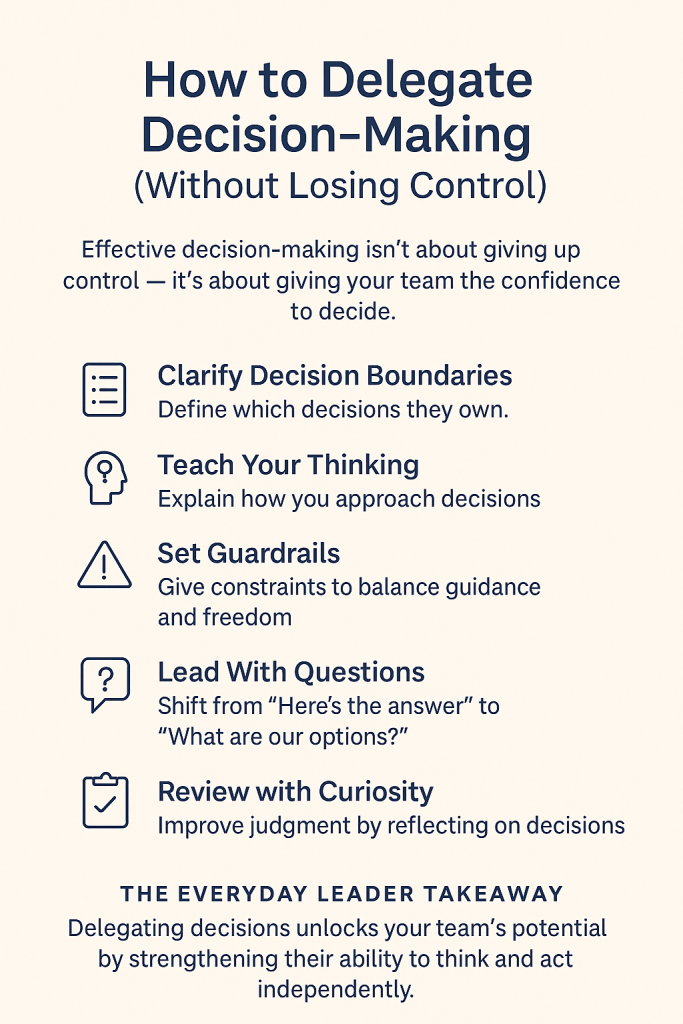
1. Clarify Which Decisions the Team Owns
Most confusion comes from decision boundaries that were never defined.
Create categories like:
- Decisions you make (high-risk, strategic, legal, financial)
- Decisions they make (operational, day-to-day, low-risk)
- Decisions you make together (developmental or ambiguous situations)
When the boundary is clear, ownership is clear — and hesitation disappears.
2. Teach Them How You Think (Not What to Think)
Your team can’t make strong decisions if they don’t understand your reasoning.
Share your “mental model” by explaining:
- What variables you weigh
- What risks matter most
- What success looks like
- What tradeoffs you consider
The more they understand your thinking, the more aligned their decisions will be — even when you’re not involved.
3. Start With Guardrails, Not Full Freedom
Decision-making grows like a muscle — gradually.
Give parameters such as:
- Budget or resource limits
- Timeline constraints
- Who must be informed
- What outcomes must be protected
Guardrails give people freedom within safety, which builds confidence without creating risk.
4. Ask Questions Instead of Giving Answers
When a team member comes to you with “What should I do?”, try:
- “What options are you considering?”
- “What outcome are you aiming for?”
- “What risks do you see?”
- “What would you do if I weren’t here?”
This shifts them from dependence → ownership.
You’re not just approving decisions — you’re developing decision-makers.
5. Review the Decision, Not the Person
When a choice doesn’t go as planned, avoid shaming or blame.
Instead focus on:
- What worked
- What didn’t
- What was learned
- How to adjust next time
Judgment improves through reflection — not fear.
Strong decision-making is a capability we build, not a performance we expect.
The Everyday Leader Takeaway
Delegating decisions isn’t about stepping back.
It’s about stepping with your team into higher ownership, stronger thinking, and faster execution.
When you:
Clarify boundaries,
Teach your thinking,
Set guardrails,
Lead with questions, and
Review decisions with curiosity…
You don’t lose control —
you gain a more capable team.
Because everyday leaders don’t create followers.
They develop leaders.


Leave a Reply