
One of the most uncomfortable moments in early leadership is when your team looks to you for direction — and you don’t feel like you have all the answers.
Maybe the project is unclear.
Maybe priorities are shifting.
Maybe you’re still waiting on information yourself.
Here’s the truth:
Great leaders don’t always have perfect clarity.
But they do create clarity for their team.
You don’t need all the information to lead.
You just need enough structure to move everyone forward.
Here’s a simple framework to lead confidently — even when things are still forming.
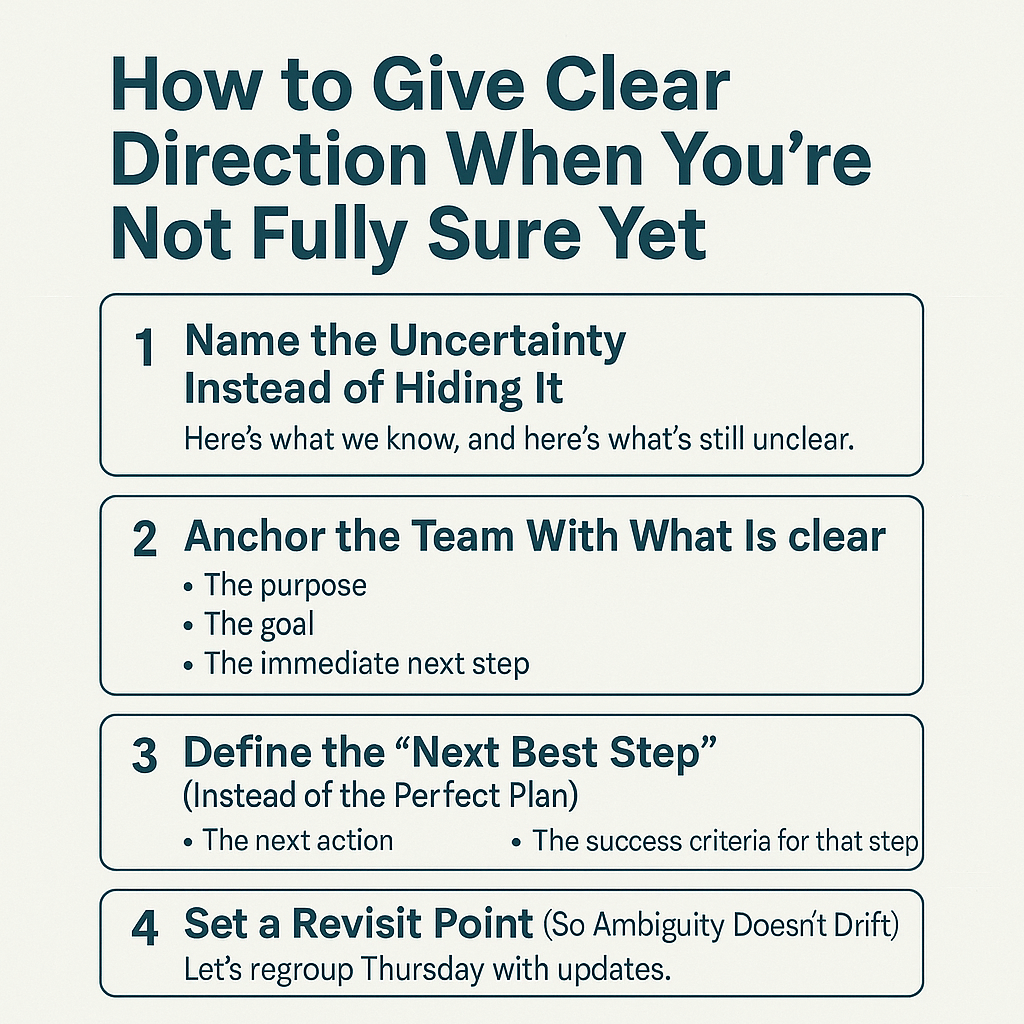
1. Name the Uncertainty Instead of Hiding It
Leaders often fear that admitting uncertainty will make them look unprepared.
But hiding it creates more confusion.
Try saying:
- “Here’s what we know, and here’s what’s still unclear.”
- “This part is still evolving, but here’s how we’ll proceed for now.”
Transparency builds trust — and gives your team context for why direction may shift.
2. Anchor the Team With What Is Clear
Even in ambiguous situations, some things are known:
- The purpose
- The goal
- The immediate next step
- The deadline (if it’s fixed)
- The impact on the team
Anchor to what’s solid.
Clarity doesn’t mean knowing everything — it means identifying what’s stable.
3. Define the “Next Best Step” (Instead of the Perfect Plan)
Your team doesn’t always need a complete roadmap.
They need momentum.
Give them:
- The next action
- The timeframe
- The success criteria for that step
Example:
“We’re still waiting for final specs, but let’s draft two options today so we’re ready once we have approvals.”
Direction is often about keeping progress moving — not finalizing the entire plan.
4. Invite Input to Increase Alignment and Buy-In
Unclear moments are opportunities for collaboration.
Ask:
- “What feels like the smartest place to start?”
- “What potential risks do you see?”
- “How would you approach this with the information we have?”
You’re not guessing alone — you’re leading a shared thought process.
5. Set a Revisit Point (So Ambiguity Doesn’t Drift)
Unclear situations can stretch on unless you set a check-in.
Use phrasing like:
- “Let’s regroup Thursday with updates.”
- “Once I get more clarity, I’ll share an updated direction.”
- “We’ll confirm or adjust at the next checkpoint.”
Revisit points give your team confidence that the ambiguity is temporary — and that you’re steering the ship.
The Everyday Leader Takeaway
You don’t need perfect clarity to lead.
You just need to create enough clarity for your team to move forward with confidence.
When you:
Name the uncertainty,
Anchor to what’s clear,
Define the next best step,
Invite input, and
Set a revisit point…
You show your team what steady leadership looks like — even in the gray.
Because everyday leaders don’t wait for certainty.
They create clarity as they go.


Leave a Reply