
One of the most common struggles for new managers is figuring out how to set boundaries without feeling guilty. You want to be supportive, responsive, and available — but when you’re always “on,” your work bleeds into your personal time, your decision-making gets cloudy, and your team starts depending on you for everything.
Here’s the truth:
Healthy boundaries don’t distance you from your team — they strengthen your ability to lead them.
Clear limits create clarity, reduce stress, and protect the energy you need to show up well.
Here’s a simple framework to help new managers set boundaries that feel firm, fair, and supportive.
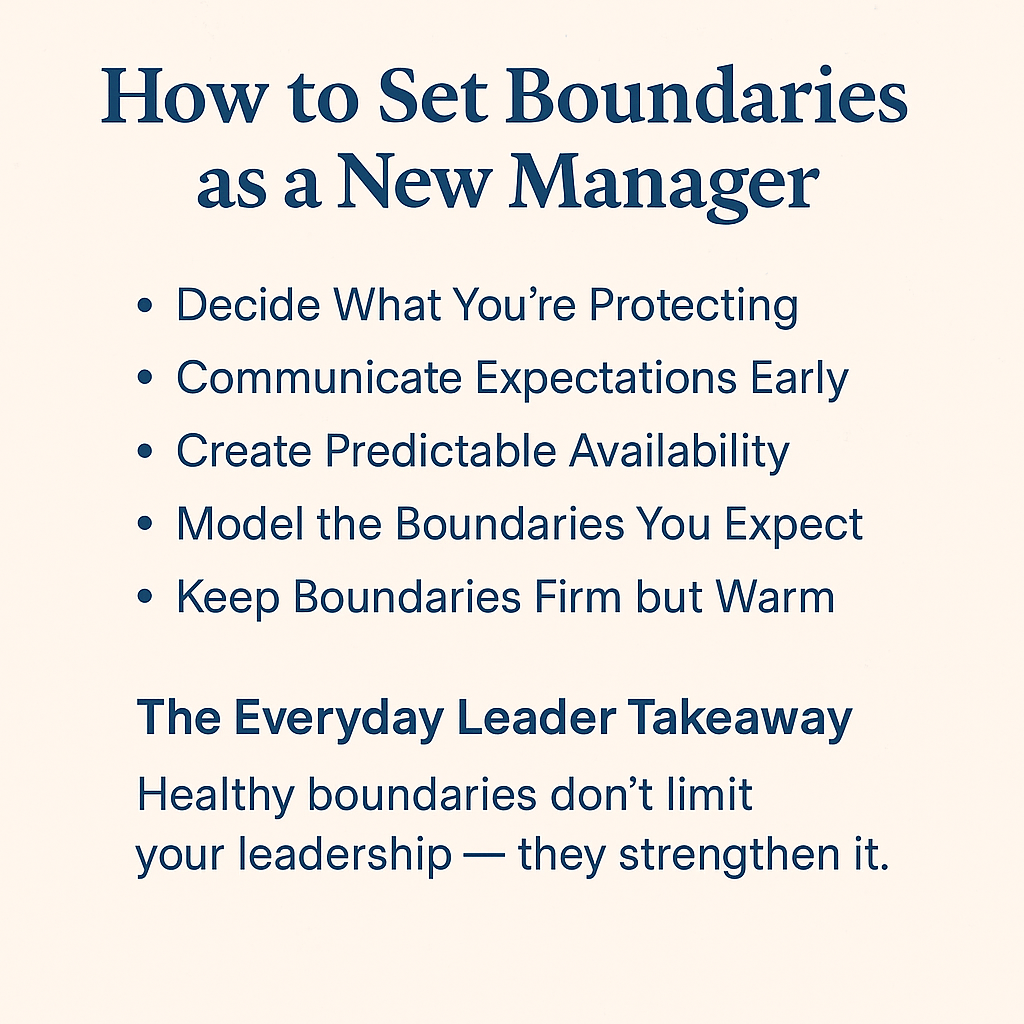
1. Decide What You’re Actually Protecting
Most managers know what they don’t want (“I don’t want late-night messages,” “I don’t want constant interruptions”).
But strong boundaries start with clarity about what you are protecting:
- Focus time
- Personal commitments
- Deep work
- Emotional capacity
- Time with family
When you name what matters, it becomes easier — and more natural — to protect it.
2. Communicate Expectations Early (Instead of Waiting Until You’re Frustrated)
Boundaries feel harsh only when they arrive suddenly.
Set expectations proactively:
- “If you need me urgently, call. Otherwise, messages after 6pm can wait until morning.”
- “I block time from 1–3pm for deep work. If something is urgent, let me know first.”
- “I’ll respond to non-urgent messages within one business day.”
Clear expectations remove guesswork — and prevent resentment on both sides.
3. Create Predictable Availability (So People Don’t Feel Shut Out)
When people know when they can reach you, they rely less on interrupting you.
Try:
- Drop-in office hours
- A shared calendar showing focus time
- Setting specific 1:1 times
- A consistent response window
Availability doesn’t mean accessibility at all times — it means reliability.
Predictability builds trust.
4. Model the Boundaries You Expect From Your Team
If you tell your team to disconnect at the end of the day but you’re sending 9pm emails, you’ve broken the boundary for everyone.
Lead with consistency:
- Delay-send non-urgent messages
- Take lunch without apologizing
- Protect your PTO
- Show your team what healthy work rhythms look like
When leaders model boundaries, the team feels permission to do the same — and burnout decreases across the board.
5. Keep Boundaries Firm but Warm
Boundaries don’t require sharpness.
They require steadiness.
Use language that is:
- Clear: “I’m unavailable at that time.”
- Supportive: “Let’s find another option that works.”
- Consistent: “As a reminder, here’s how we handle this.”
Warm tone + steady clarity = respected boundaries.
You’re not being difficult.
You’re being intentional.
The Everyday Leader Takeaway
Healthy boundaries don’t limit your leadership — they strengthen it.
When you:
Decide what you’re protecting,
Communicate expectations early,
Create predictable availability,
Model the behaviors you want to see, and
Hold boundaries with warmth…
You show your team what sustainable leadership looks like.
Because everyday leaders don’t burn out to prove their commitment.
They set boundaries so they can lead well — today and long-term.


Leave a Reply