
As a first-time manager, your calendar quickly becomes your biggest enemy. You went from attending necessary project meetings to being invited to everything—often with the note, “optional, but recommended.” Saying yes to every one of those “optional” invitations quickly drains your focus and robs your team of your valuable time.
You’re not alone; meeting proliferation is a challenge in almost every organization. Great leaders don’t just attend meetings; they treat their time—and their team’s time—as the most precious resource. Here’s a simple framework, the R.O.C. Filter, to help you drastically reduce meeting overload and clarify attendance expectations.
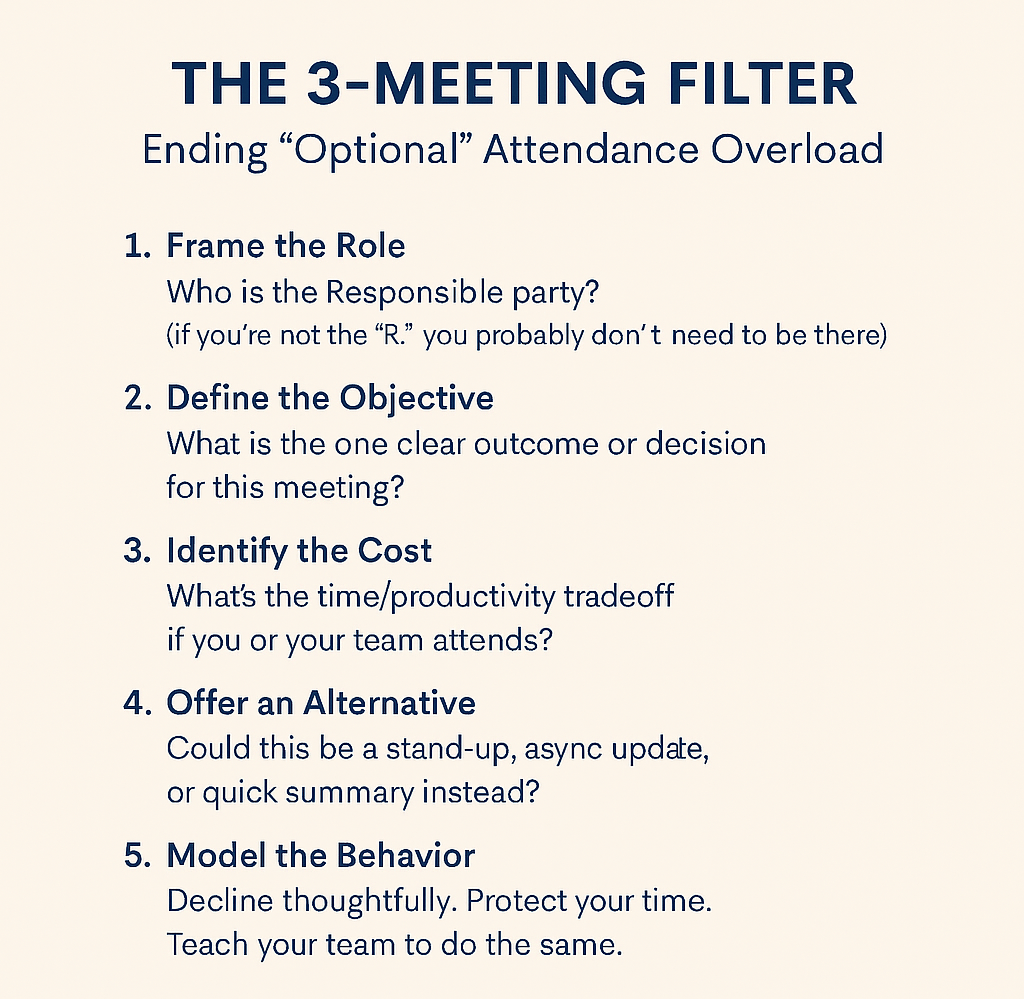
1. Frame the Role: Who is the Responsible Party?
New managers often feel obligated to attend meetings simply because the subject matter touches their team’s work. This leads to them acting as passive information conduits.
Instead, clarify who is the single Responsible party (the owner of the outcome) for the work being discussed. If you or your direct report is not the R, your attendance is likely for Information Only. You should designate one person to attend, or request the meeting be recorded, rather than having multiple people present. For example: “If my team isn’t driving the decision, I’ll attend for the first 15 minutes only, or ask for the notes.”
2. Define the Objective: What is the Clear Outcome?
Most “optional” meetings suffer from a fuzzy agenda; they feel like “updates” or “discussions” rather than concrete decision-making sessions. This makes it impossible to judge their value.
Before accepting any invitation, identify the single, measurable Outcome required. If the organizer cannot clearly state the one thing that will be different after the meeting, politely decline or push back on the format. A simple question starter is: “What is the one decision or deliverable we must have by the end of this hour?”
3. Identify the Cost: What is the Hidden Constraint?
Every hour spent in a meeting is an hour not spent on focused work, coaching, or strategy. New managers often ignore this constraint because it feels less urgent than replying “Yes” to an invitation.
Before accepting, tally the hidden cost: If four people from your team attend a two-hour meeting, that is eight hours of lost productivity. Consider the financial or deadline Constraint this meeting imposes. Say: “I’d love to attend, but that meeting represents 8 hours of lost coding time; is there a 15-minute summary I could join instead?”
4. Propose a “Stand-Up” or Asynchronous Alternative
Many team updates or status checks are masquerading as meetings because it’s the easiest format for the organizer. The real work could often be done in 10 minutes or less.
When you encounter a recurring, optional meeting that has no clear Outcome, propose a more efficient format. Suggest an asynchronous update via a shared document, or convert the meeting to a quick, 10-minute standing huddle. This respects everyone’s time. For example: “Can we switch this to a 10-minute stand-up at the start of the week to save everyone 50 minutes?”
5. Model the Behavior You Want Your Team to Adopt
Your team is watching you. If you attend every optional meeting and accept calendar invitations without question, you are silently telling them their time is not sacred.
Be selective about your own attendance, and let your team members know why you are declining certain invitations. This gives them permission (and the language) to protect their own calendars. By visibly enforcing the R.O.C. Filter on your own schedule, you empower your team to do the same.
THE EVERYDAY LEADER TAKEAWAY
Everyday leaders don’t just manage tasks; they fiercely manage time. They use systems like the R.O.C. Filter to create clarity and focus, ensuring everyone is spending their hours delivering value, not just sitting in a chair.


Leave a Reply