
One of the hardest lessons for new managers is realizing that saying yes to everything is not a sign of commitment — it’s a fast track to burnout, misalignment, and diluted leadership.
When you’re new, it’s tempting to say yes to every request. You want to be helpful. You want to prove yourself. You don’t want to disappoint anyone.
But leadership isn’t about being endlessly available.
It’s about making intentional choices with limited time and energy.
Here’s a simple framework to help you say no with clarity, confidence, and respect — without harming trust or relationships.
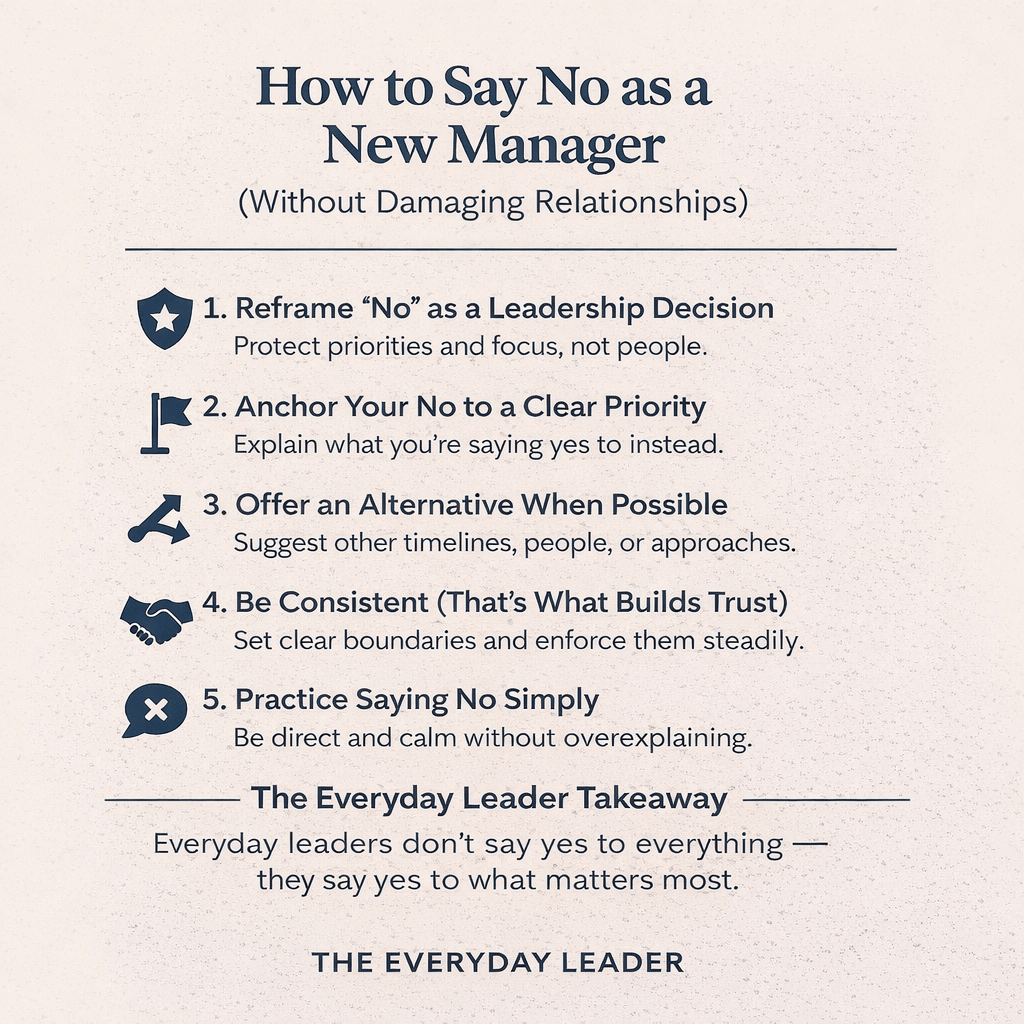
1. Reframe “No” as a Leadership Decision
Many new managers treat “no” as a personal rejection.
It’s not.
Saying no is often a decision in service of priorities, not people.
You’re protecting focus, commitments, and outcomes — for yourself and your team.
When you shift your mindset from “I’m letting someone down” to “I’m making a leadership call,” saying no becomes steadier and less emotional.
2. Anchor Your No to a Clear Priority
A vague no feels abrupt.
A grounded no feels thoughtful.
Try anchoring your response to what you are saying yes to:
- “I can’t take this on because my focus this week is ___.”
- “This would pull time away from a priority we committed to.”
Clarity reduces friction — and shows your decisions are intentional, not arbitrary.
3. Offer an Alternative When Possible
Saying no doesn’t mean shutting the door completely.
You might:
- Suggest a different timeline
- Recommend another person
- Propose a lighter version of the ask
- Offer guidance instead of ownership
This communicates support without overcommitting — and keeps relationships intact.
4. Be Consistent (That’s What Builds Trust)
Inconsistency creates confusion and resentment.
If you sometimes say yes out of guilt and other times say no out of exhaustion, people won’t understand your boundaries.
Consistency helps others learn:
- When to ask
- What to expect
- How to prioritize alongside you
Clear patterns build credibility faster than over-accommodation.
5. Practice Saying No Simply — Without Overexplaining
You don’t need a long justification to say no well.
Strong leadership language sounds like:
- “I can’t commit to that right now.”
- “That’s not something I can take on.”
- “I need to protect my focus on ___.”
Overexplaining often signals doubt.
Simple, calm language signals confidence.
The Everyday Leader Takeaway
Saying no doesn’t make you unhelpful — it makes you intentional.
When you:
Reframe no as leadership,
Anchor decisions to priorities,
Offer alternatives thoughtfully,
Stay consistent, and
Communicate with calm clarity…
You earn trust, protect your energy, and lead with purpose.
Because everyday leaders don’t say yes to everything.
They say yes to what matters most.


Leave a Reply