
For many new managers, taking time off feels harder than it should.
Your inbox keeps moving. Decisions still need to be made. Your team might need support. And somewhere in the background is the quiet fear that stepping away means you’re falling behind.
But here’s the truth most leaders learn the hard way:
Constant availability is not the same as strong leadership.
Time off isn’t a reward for finishing everything.
It’s a requirement for leading well — especially over the long term.
As the year winds down, here’s a simple framework for why rest matters — and how stepping away actually makes you a better leader.
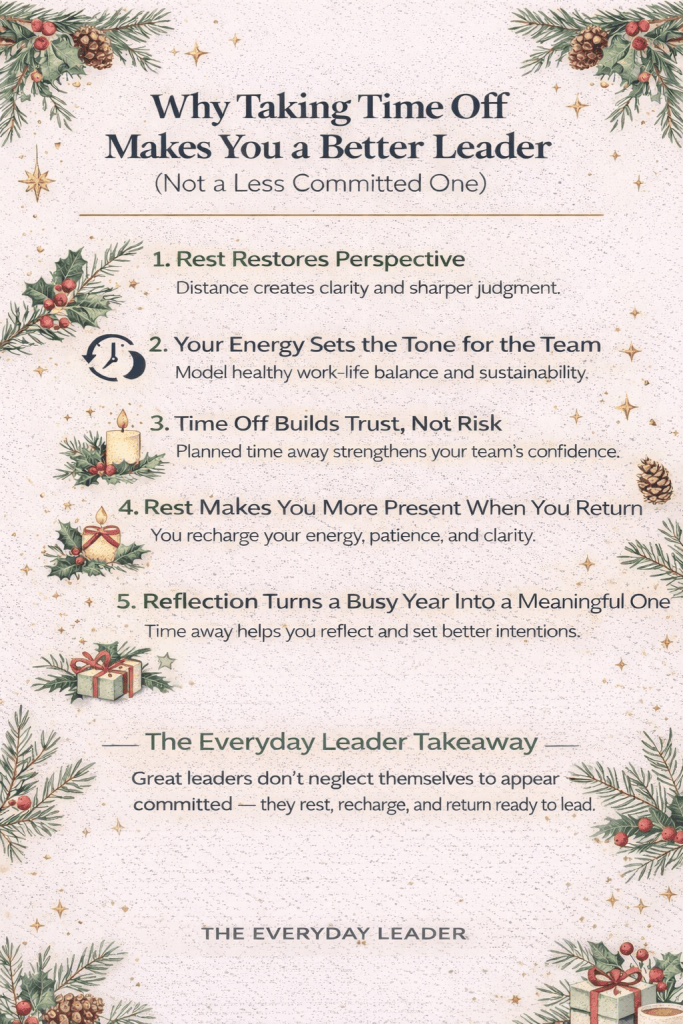
1. Rest Restores Perspective
When you’re constantly “in it,” everything feels urgent. Small problems feel big. Decisions feel heavier.
Time off creates distance — and distance creates clarity.
When you step away:
- You see patterns instead of noise
- You reconnect to what actually matters
- You return with sharper judgment
Perspective is one of a leader’s greatest tools — and it’s impossible to access when you never pause.
2. Your Energy Sets the Tone for the Team
Leaders don’t just manage work.
They model behavior.
When you never disconnect, your team learns:
- Rest is optional
- Burnout is normal
- Being “on” all the time is expected
But when you take real time off — and encourage others to do the same — you signal that sustainability matters. Healthy teams start with healthy leaders.
3. Time Off Builds Trust, Not Risk
New managers often worry that stepping away will expose gaps or create problems.
In reality, planned time off:
- Reveals where systems are strong
- Highlights where ownership needs to grow
- Builds confidence in your team’s capability
If everything breaks when you step away, that’s not a failure — it’s valuable information. Leadership isn’t about being indispensable. It’s about building teams that can function without you.
4. Rest Makes You More Present When You Return
Burned-out leaders may be physically present — but mentally checked out.
Rested leaders:
- Listen better
- React less emotionally
- Communicate more clearly
- Lead with patience instead of pressure
Time off doesn’t reduce your impact.
It sharpens it.
5. Reflection Turns a Busy Year Into a Meaningful One
Time away isn’t just about rest — it’s about reflection.
As the year closes, ask yourself:
- What worked well this year?
- What drained me more than I expected?
- Where did I grow as a leader?
- What do I want to do differently next year?
Reflection transforms experience into wisdom — and wisdom is what carries leaders forward.
The Everyday Leader Takeaway
Taking time off isn’t stepping back from leadership.
It’s stepping into it with intention.
When you:
Create space to rest,
Model healthy boundaries,
Trust your team,
Recharge your energy, and
Reflect on what matters…
You return not just refreshed — but renewed.
Because everyday leaders don’t run themselves into the ground to prove commitment.
They rest, recharge, and lead with clarity — for the long run.


Leave a Reply