
The days after Christmas can feel strangely disorienting.
You’ve stepped away. Your routine was disrupted. Your inbox is full. And suddenly, you’re expected to flip the switch back to full productivity.
For many new managers, this transition is harder than expected.
You don’t want to undo the rest you just took — but you also don’t want to fall behind.
Here’s the truth: strong leaders don’t sprint back into work.
They re-enter intentionally.
Here’s a simple framework to help you return after time off with clarity, calm, and momentum.
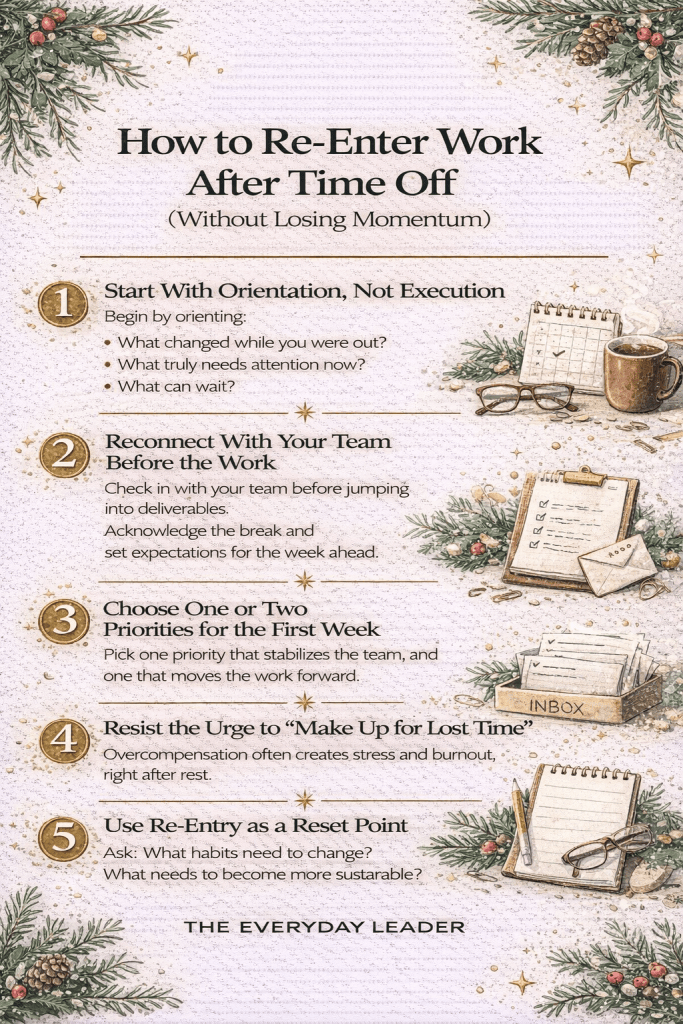
1. Start With Orientation, Not Execution
The biggest mistake leaders make after time off is diving straight into tasks.
Instead, begin by orienting:
- What changed while you were out?
- What truly needs attention now?
- What can wait?
Give yourself permission to re-enter before you execute.
Clarity always comes before speed.
2. Reconnect With Your Team Before the Work
Work moves better when people feel connected.
Before jumping into deliverables:
- Check in with how people are doing
- Acknowledge the break
- Set expectations for the week ahead
A few intentional minutes of connection can save hours of friction later.
3. Choose One or Two Priorities for the First Week
Not everything needs to be done immediately.
Pick:
- One priority that stabilizes the team
- One priority that moves the work forward
Momentum is built through focused progress — not frantic activity.
4. Resist the Urge to “Make Up for Lost Time”
Time off is not a setback that needs to be corrected.
Trying to overcompensate often leads to:
- Rushed decisions
- Unnecessary stress
- Burnout right after rest
Trust that rest was productive — even if it doesn’t show up on a task list.
5. Use Re-Entry as a Reset Point
The days after a break are powerful for adjustment.
Ask yourself:
- What did I miss not doing?
- What habits don’t need to return?
- What would make this season more sustainable?
Re-entry is an opportunity — not just a transition.
The Everyday Leader Takeaway
Coming back to work isn’t about picking up where you left off.
It’s about choosing how you move forward.
When you:
Re-orient before executing,
Reconnect before assigning,
Focus before reacting, and
Use re-entry as a reset…
You protect the value of rest — and build sustainable momentum.
Because everyday leaders don’t rush back into work.
They return with intention.


Leave a Reply