
Leadership doesn’t pause when you’re tired.
Deadlines still exist. Your team still needs direction. Decisions still need to be made — even on days when your energy feels low and your emotional bandwidth is thin.
For new managers, this can feel especially heavy. You may worry that feeling drained means you’re failing, unmotivated, or not cut out for leadership.
Here’s the truth: feeling depleted doesn’t mean you’re a bad leader.
It means you’re human.
The key isn’t pushing through endlessly — it’s learning how to lead responsibly when your energy is limited.
Here’s a simple framework to help you lead with steadiness, even on low-capacity days.
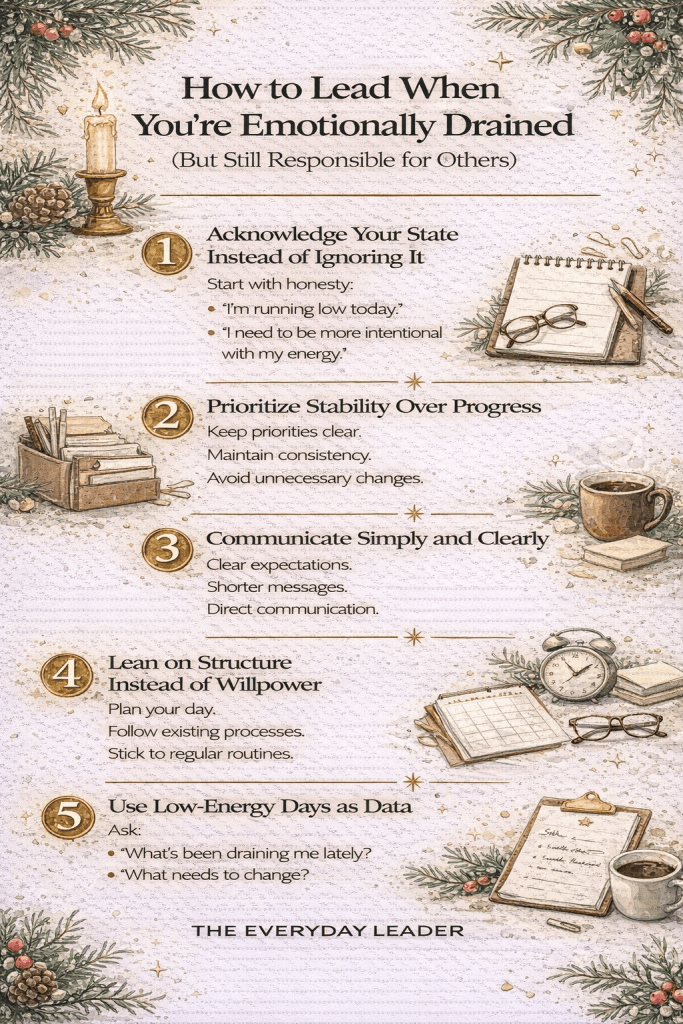
1. Acknowledge Your State Instead of Ignoring It
Many leaders try to power through exhaustion without naming it — even to themselves.
Ignoring how you feel doesn’t make it go away.
It just makes your reactions sharper and your patience shorter.
Start with honesty:
- “I’m running low today.”
- “I need to be more intentional with my energy.”
Self-awareness is a leadership skill — not a weakness.
2. Prioritize Stability Over Progress
On low-energy days, your goal isn’t growth.
It’s stability.
Focus on:
- Keeping priorities clear
- Preventing confusion
- Maintaining consistency
- Avoiding unnecessary changes
A calm, steady leader is far more valuable than an exhausted one trying to overperform.
3. Communicate Simply and Clearly
When emotional energy is low, complexity becomes overwhelming — for you and your team.
Lean into:
- Clear expectations
- Fewer decisions
- Shorter messages
- Direct communication
Clarity reduces cognitive load — and preserves trust.
4. Lean on Structure Instead of Willpower
This is where systems matter.
Let:
- Your calendar guide your day
- Existing processes carry the work
- Regular check-ins replace ad-hoc decisions
Structure allows leadership to continue even when motivation dips.
5. Use Low-Energy Days as Data
Instead of judging yourself, get curious.
Ask:
- What’s been draining me lately?
- What patterns am I noticing?
- What needs to change to make this sustainable?
Burnout isn’t a failure signal — it’s a feedback signal.
The Everyday Leader Takeaway
Leadership doesn’t require constant energy — it requires consistency and awareness.
When you:
Acknowledge your limits,
Focus on stability,
Communicate clearly,
Rely on structure, and
Learn from low-energy moments…
You lead with maturity and resilience.
Because everyday leaders don’t pretend they’re always at 100%.
They lead responsibly — even on hard days.


Leave a Reply